

Alina presents her work at ICANN
15 Sep 2026Congratulations to Alina for presenting a paper at the International Conference on Artificial Neural Networks. She travelled to Padua, Italy, and gave a 20-minute talk in the Special session on Spiking Neural Networks and Neuromorphic Computing.
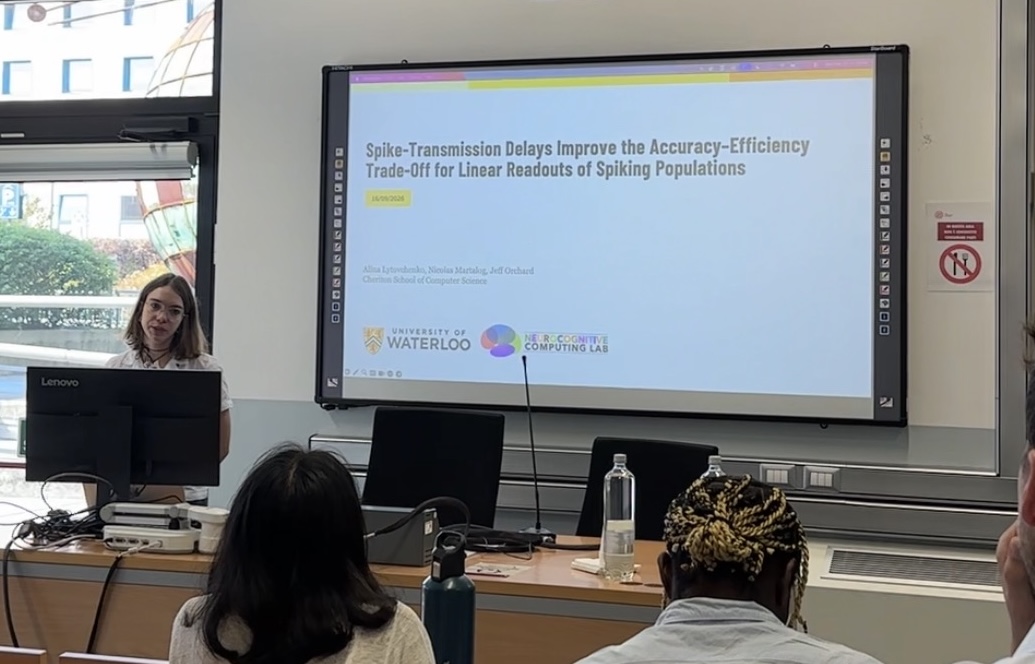
Spike-Transmission Delays Improve the Accuracy–Efficiency Trade-Off for Linear Readouts of Spiking Populations
- A Lytovchenko, N Martalog, J Orchard
Linear decoders for spiking populations typically use only the instantaneous filtered activity of each neuron and therefore do not fully exploit the temporal structure present in neural responses. We study a delay-augmented linear readout in which each neuron contributes several time-shifted copies of its activity, giving the decoder access to recent response history without introducing recurrence or nonlinear processing. To ensure a fair comparison, we keep the total number of decoder inputs fixed across conditions: when more delay taps are added per neuron, the number of neurons is reduced accordingly. On one-dimensional reconstruction of band-limited white-noise signals, we compare this approach with a baseline readout that uses current activity alone in populations of leaky integrate-and-fire (LIF) and adaptive LIF (ALIF) neurons. Delay-augmented decoding improves accuracy under matched decoder dimensionality, with gains that depend on signal timescale and firing regime. The largest improvements occur for ALIF populations and reach nearly 40% relative MSE reduction in the best settings, while LIF populations show smaller and more regime-dependent benefits. These results show that fixed spike-transmission delays can improve decoding efficiency without recurrence or learned temporal dynamics. (pdf)
Congratulations to Alina, Nicolas, and Jeff!